










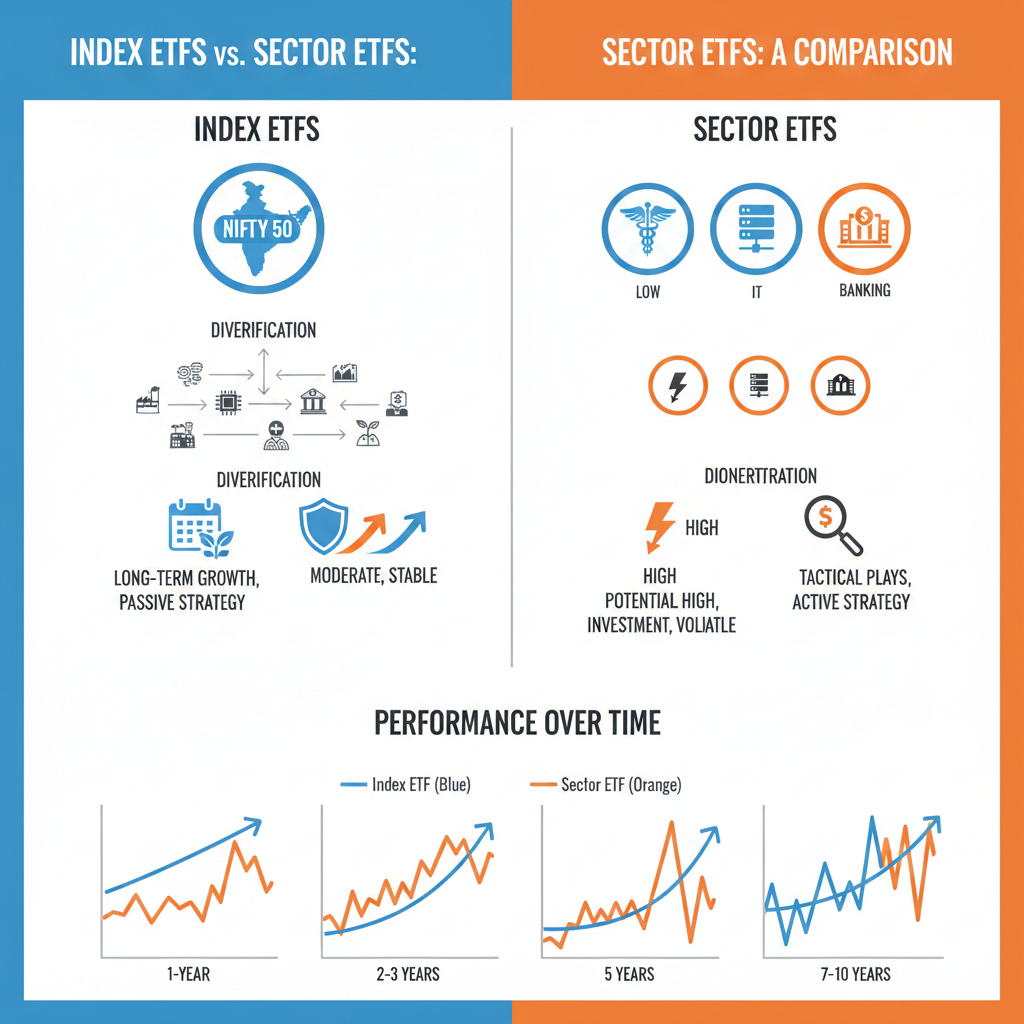




















If you’re just getting started with ETF investments, you might face a common dilemma. Most investors wonder whether to go for a broad index ETF or a sector ETF.
Sector ETFs appeal to investors at first glance because they provide the option to grow with specific themes like Pharma, IT, Banking or Energy. On the other hand, index ETFs are known for their stability and the ability to create long-term wealth through diversification. So, how do you decide where to invest?
That’s exactly what we have discussed in this blog. Read on to know the differences and performance considerations before investing.
What Are Index ETFs?
Index ETFs track a broad market index, like Nifty 50, Nifty 100, or Nifty 500. They reflect the same index composition and weightage, so that you get stable exposure across different sectors or market caps.
For instance, a Nifty 500 ETF:
- Covers companies across the large, mid, and small-cap sectors
- Includes all major sectors
- Involves lower volatility
- Provides risk-adjusted returns
- It is ideal for long-term compounding and SIP investing
The goal of Index ETFs is to match the market, but not beat it. However, the steady impact of compounding often outperforms most active strategies over long periods.
What Are Sector ETFs?
As the name suggests, Sector ETFs track only a particular industry like pharma, banking, FMCG, IT, PSU, or metals. For instance, a pharma ETF invests exclusively in pharmaceutical and healthcare stocks.
They are beneficial when:
- A particular sector enters an expansion cycle
- An industry benefits from changes in policy
- Shifts in global demand impact specific businesses positively
- Investors look for targeted exposure
However, when you concentrate your investments on a certain sector, you’re susceptible to volatility. Sector cycles can lead to sharp swings in returns.
Key Differences Between Index and Sector ETFs
We have explained the key differences between Index and Sectoral ETFs under the key parameters.
1. Diversification
Index ETFs are extremely diversified across different sectors and market caps. On the contrary, sector ETFs are concentrated, which exposes you to high risk if the entire sector underperforms.
2. Risk
The broad basket of stocks exposes index ETFs to lower risk. Sector ETFs involve higher volatility, as downturns can hit them severely.
3. Returns
The returns from index ETFs are generally steady as returns compound. Sector ETFs deliver periodic bursts of high returns, but you might experience years of underperformance.
4. Ideal Investor
If you’re a long-term passive investor who prioritises stability, go for index ETFs. On the other hand, investors who track sector cycles and want tactical exposure can benefit from sector ETFs.
Trend Comparison Across Different Investment Periods
In this table, check how each type of ETF performs over different time horizons.
| Time Period | Nifty ETFs | Sector ETFs |
| 1-Year | Usually tracks the overall market with moderate moves | Highly cyclical and may outperform or underperform sharply |
| 2-3 Years | More stable trend lines | Strong if sector tailwinds exist (e.g., regulatory support, global demand) |
| 5 Years | Offers consistent compounding | The sector may see big swings and strong cycles, followed by flat phases |
| 7-10 Years | Broad indices outperform due to economic expansion | Sector ETFs generally underperform diversified indices over long horizons |
Conclusion
The choice of ETFs ultimately comes down to the individual investor profile. Before investing, consider your goal, investment horizon, and risk tolerance.
If you want to build long-term wealth, go for index ETFs. Ideally, these are suitable for building retirement portfolios or accumulating wealth for buying a house. However, if you want to accumulate wealth for the short term, choose sector ETFs.
Ideally, investors must balance both these strategies, considering their individual financial profiles. While Index ETFs can form your core portfolio, use sector ETFs to serve as performance boosters when these cycles turn favourable.
Adopt the right mix of investment strategies to capture growth in the long-term while you capitalise on shorter-term sector opportunities.